A Practical Guide to End-to-End Machine Learning Workflows
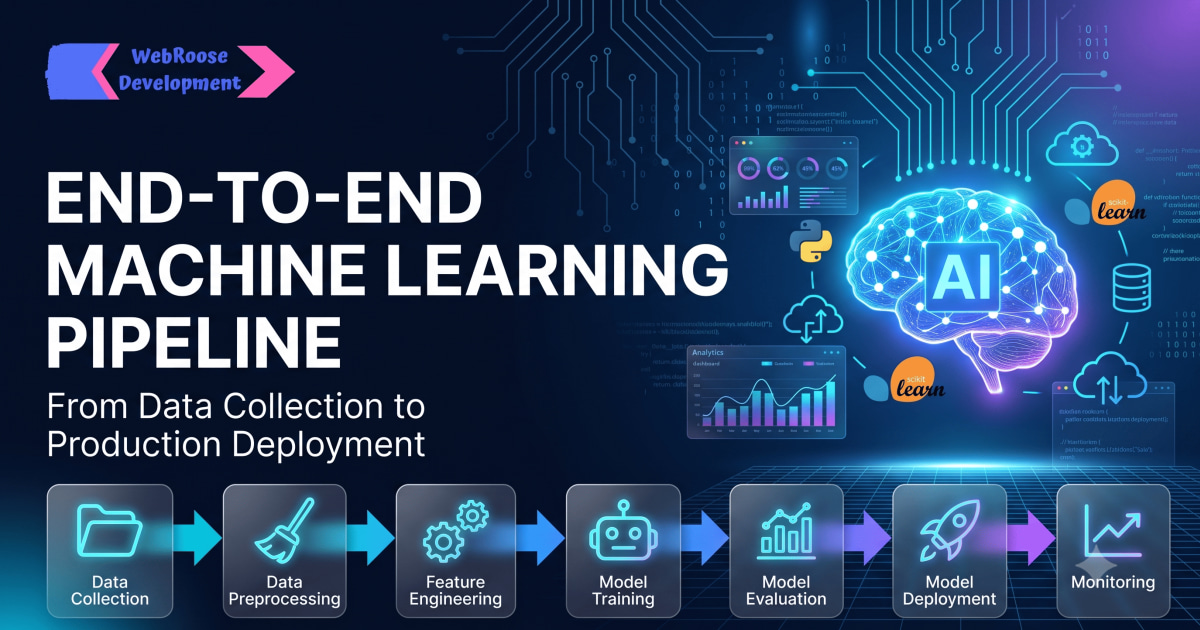
Have you ever built a machine learning model that performed exceptionally well in a Jupyter Notebook, only to struggle when deploying it in the real world? You're not alone. Many machine learning projects fail not because the model is bad, but because there's no well-structured pipeline connecting data collection, preprocessing, training, evaluation, deployment, and monitoring. That's where an end-to-end machine learning pipeline becomes essential.
An end-to-end machine learning pipeline is a structured workflow that manages every stage of the machine learning lifecycle from collecting raw data and preparing it for analysis to training, evaluating, deploying, and monitoring models. Instead of treating these tasks as separate steps, a pipeline connects them into a repeatable process, making your machine learning projects more reliable, scalable, and easier to maintain as they grow.
In this guide, you'll learn how to build an end-to-end machine learning pipeline from scratch, covering every stage-from data collection and preprocessing to model training, deployment, and monitoring. Along the way, we'll explore industry best practices, practical implementation strategies, and common challenges you'll encounter in real-world projects.
A Brief History of Machine Learning
The story of machine learning began in 1959, when Arthur Samuel, an IBM researcher and one of the pioneers of artificial intelligence, coined the term "machine learning." Through his groundbreaking work on a self-improving checkers program, Samuel demonstrated that computers could improve their performance by learning from experience rather than relying solely on hard-coded instructions. What started as a revolutionary research idea has since evolved into one of the most influential technologies of the 21st century, powering recommendation systems, fraud detection, autonomous vehicles, medical diagnosis, language translation, and countless other intelligent applications that millions of people use every day.
What is ML pipeline?
A Machine Learning (ML) pipeline is a structured workflow that automates and organises every stage of the machine learning lifecycle. Rather than treating tasks such as data collection, preprocessing, feature engineering, model training, evaluation, deployment, and monitoring as separate activities, an ML pipeline connects them into a single, repeatable process.
The primary purpose of an ML pipeline is to transform experimental machine learning projects into reliable, production-ready systems. In many organisations, building an accurate model is only the first step. The real challenge lies in ensuring that the model can process new data consistently, scale with increasing workloads, integrate with existing applications, and maintain its performance over time.
Without a well-defined pipeline, machine learning workflows often become difficult to reproduce, maintain, and deploy. Data preprocessing may differ between experiments, model versions can become difficult to track, and manual processes increase the likelihood of errors. These challenges are among the main reasons why many promising machine learning projects never progress beyond the prototype stage.
An end-to-end ML pipeline addresses these issues by automating repetitive tasks, standardising workflows, and enabling continuous monitoring throughout the model's lifecycle. This allows data scientists and machine learning engineers to spend less time managing infrastructure and repetitive processes, and more time improving model performance and delivering business value.

Figure 1: End-to-end machine learning pipeline workflow from Problem Statement to deployment.
Key Components of an End-to-End Machine Learning Pipeline
The diagram above illustrates the complete lifecycle of a machine learning project. Each stage has a specific responsibility, and together they form a structured workflow that transforms raw data into a production-ready machine learning model. Rather than treating these steps as isolated tasks, an ML pipeline connects them into a repeatable and scalable process, ensuring consistency, reliability, and easier maintenance.
Let's explore each stage in detail.
1. Problem Statement
Every successful machine learning project begins with a clearly defined problem. Before collecting data or selecting algorithms, it's important to understand the business objective and determine whether machine learning is the right solution. A well-defined problem statement helps identify the target variable, success metrics, project constraints, and expected outcomes.
2. Data Collection
Data is the foundation of every machine learning model. At this stage, relevant data is gathered from sources such as databases, APIs, CSV files, cloud storage, sensors, or web scraping. The quality and diversity of the collected data have a significant impact on the model's final performance.
3. Exploratory Data Analysis (EDA)
Once the data is collected, exploratory data analysis helps uncover patterns, relationships, and potential issues within the dataset. Using statistical summaries and visualisations, data scientists identify missing values, outliers, feature distributions, and correlations that influence model development.
4. Data Preprocessing
Raw data is rarely suitable for training a machine learning model. During preprocessing, missing values are handled, duplicate records are removed, categorical variables are encoded, and data is cleaned to improve consistency. This stage prepares the dataset for effective model training.
5. Train-Test Split
The dataset is divided into training and testing sets. The training set is used to teach the model, while the testing set evaluates how well it performs on unseen data. This helps measure the model's ability to generalise instead of simply memorising the training data.
6. Feature Scaling
Many machine learning algorithms perform better when numerical features are on a similar scale. Feature scaling techniques such as Standardization and Min-Max Normalization ensure that variables with larger values do not dominate the learning process.
7. Model Training
At this stage, a suitable machine learning algorithm is selected and trained using the prepared dataset. During training, the model learns patterns and relationships within the data to make predictions on new, unseen examples.
8. Model Evaluation
After training, the model's performance is assessed using evaluation metrics such as Accuracy, Precision, Recall, F1-Score, ROC-AUC, or RMSE, depending on the problem type. This step helps determine whether the model is suitable for deployment or requires further improvement.
9. Hyperparameter Tuning
Machine learning models contain hyperparameters that influence their behaviour. Techniques such as Grid Search, Random Search, or Bayesian Optimization are used to find the optimal combination of hyperparameters that maximises model performance.
10. Model Deployment
Once validated, the model is deployed into a production environment where it can generate predictions for real-world users. Deployment commonly involves APIs, cloud platforms, Docker containers, or Kubernetes-based infrastructure.
Implementation code
# Step 1: Import Required Libraries
import numpy as np
import pandas as pd
from sklearn.model_selection import train_test_split
from sklearn.preprocessing import StandardScaler, OneHotEncoder
from sklearn.pipeline import Pipeline
from sklearn.compose import ColumnTransformer
from sklearn.ensemble import RandomForestClassifier
from sklearn.metrics import accuracy_score
import joblib  # For saving and loading models

# Step 2: Load and Prepare the Data
# Load dataset (Titanic dataset as an example)
df = pd.read_csv("https://raw.githubusercontent.com/datasciencedojo/datasets/master/titanic.csv")

# Select relevant features
features = ['Pclass', 'Sex', 'Age', 'SibSp', 'Parch', 'Fare', 'Embarked']
df = df[features + ['Survived']].dropna()  # Drop rows with missing values

# Display the first few rows of the dataset
print("Data Sample:\n", df.head())

# Step 3: Define Preprocessing Steps
# Define numerical and categorical features
num_features = ['Age', 'SibSp', 'Parch', 'Fare']
cat_features = ['Pclass', 'Sex', 'Embarked']

# Define transformers for preprocessing
num_transformer = StandardScaler()  # Standardize numerical features
cat_transformer = OneHotEncoder(handle_unknown='ignore')  # One-hot encode categorical features

# Combine transformers into a single preprocessor
preprocessor = ColumnTransformer([
    ('num', num_transformer, num_features),
    ('cat', cat_transformer, cat_features)
])

# Step 4: Split Data into Training and Testing Sets
# Define target and features
X = df[features]
y = df['Survived']

# Split into training and testing sets (80% train, 20% test)
X_train, X_test, y_train, y_test = train_test_split(X, y, test_size=0.2, random_state=42)

print(f"Training set shape: {X_train.shape}")
print(f"Testing set shape: {X_test.shape}")

# Step 5: Build the Machine Learning Pipeline
# Define the pipeline (includes preprocessing + RandomForest classifier)
pipeline = Pipeline([
    ('preprocessor', preprocessor),  # Apply preprocessing steps
    ('classifier', RandomForestClassifier(n_estimators=100, random_state=42))  # ML model (RandomForest)
])

# Step 6: Train the Model
# Train the model using the pipeline
pipeline.fit(X_train, y_train)
print("Model training complete!")

# Step 7: Evaluate the Model
# Make predictions on the test data
y_pred = pipeline.predict(X_test)

# Compute accuracy of the model
accuracy = accuracy_score(y_test, y_pred)
print(f"Model Accuracy: {accuracy:.2f}")

# Step 8: Save and Load the Model
# Save the trained pipeline (preprocessing + model)
joblib.dump(pipeline, 'ml_pipeline.pkl')

# Load the model back
loaded_pipeline = joblib.load('ml_pipeline.pkl')

# Predict using the loaded model
sample_data = pd.DataFrame([{'Pclass': 3, 'Sex': 'male', 'Age': 25, 'SibSp': 0, 'Parch': 0, 'Fare': 7.5, 'Embarked': 'S'}])
prediction = loaded_pipeline.predict(sample_data)

# Output prediction for a sample input
print(f"Prediction for Sample Data: {'Survived' if prediction[0] == 1 else 'Did not Survive'}")
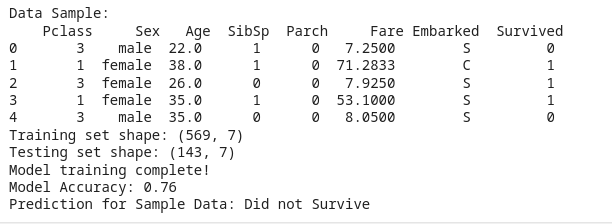
Output
Conclusion
An end-to-end machine learning pipeline is more than just a sequence of tasks-it is a structured framework that transforms raw data into reliable, production-ready machine learning solutions. By integrating data collection, preprocessing, model training, evaluation, deployment, and monitoring into a single workflow, pipelines improve reproducibility, reduce manual effort, and make machine learning systems easier to maintain and scale.
As machine learning continues to power applications across industries, understanding how to build and manage end-to-end workflows has become an essential skill for data scientists and machine learning engineers. By applying the concepts and implementation covered in this guide, you can develop robust ML pipelines that not only perform well during experimentation but also deliver consistent and reliable results in real-world production environments.
FAQs
It's a structured, repeatable workflow that connects every stage of a machine learning project — data collection, preprocessing, training, evaluation, deployment, and monitoring — instead of handling each step separately. This makes projects more reliable, scalable, and easier to maintain as they grow.
Without a pipeline, preprocessing steps can differ between experiments, model versions get hard to track, and manual work introduces errors. A pipeline standardizes and automates these steps, which is often the difference between a model that works in a notebook and one that actually makes it to production.
Ten core stages: defining the problem statement, data collection, exploratory data analysis, data preprocessing, train-test split, feature scaling, model training, model evaluation, hyperparameter tuning, and deployment.
In Python, scikit-learn's Pipeline and ColumnTransformer are common for chaining preprocessing and modeling steps, alongside pandas for data handling and joblib for saving/loading trained models. For deployment, APIs, Docker containers, and Kubernetes are typical.
Deployment isn't the end — models need ongoing monitoring to make sure performance holds up as new data comes in. A well-built pipeline treats monitoring as a continuous stage, not an afterthought.