Apple Is Ending Support for Intel-Based Apps on macOS: What It Means for Developers and Users
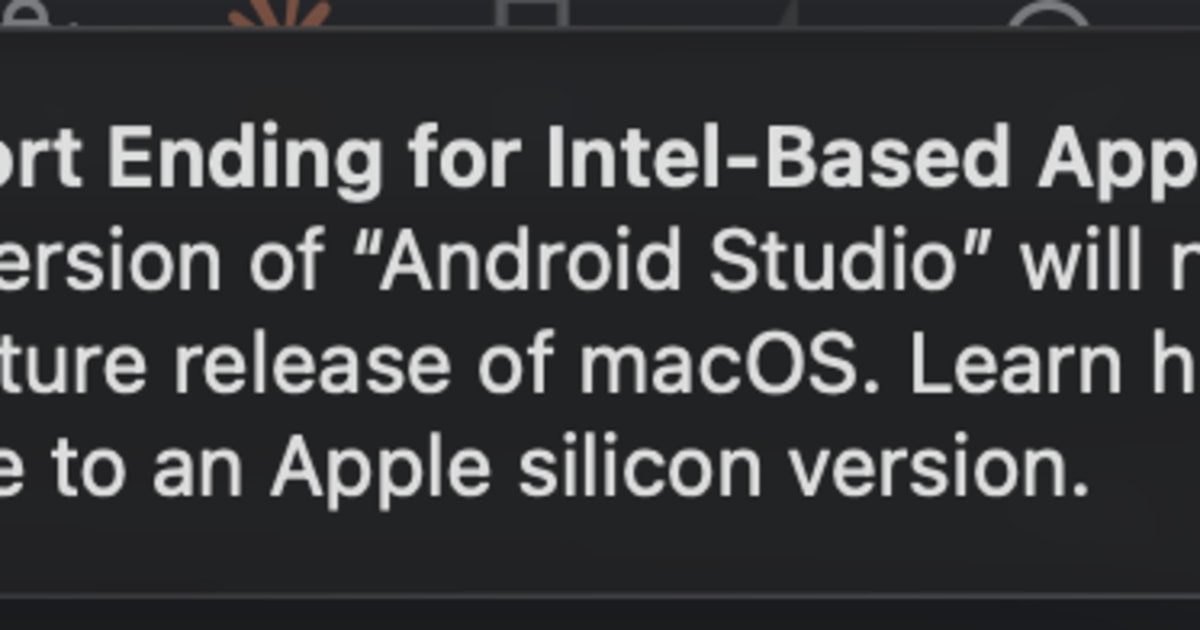
Recently, many macOS users started seeing a warning message while opening apps like Android Studio:
“Support Ending for Intel-Based Apps”
This notification has raised concerns across the developer community, especially among users still relying on Intel-only applications through Rosetta 2 on Apple Silicon Macs.

What Is Happening?
Apple officially announced that support for Rosetta 2 — the translation layer allowing Intel-based applications to run on Apple Silicon Macs — will gradually phase out in future versions of macOS.
Rosetta 2 was introduced in 2020 during Apple’s transition from Intel processors to Apple Silicon chips like the M1, M2, M3, and newer generations. It allowed older Intel apps to continue working seamlessly on modern Macs.
Now, Apple is preparing to complete that transition.
Timeline of Rosetta 2 Support
According to Apple:
- Rosetta 2 will remain fully available through macOS 27.
- Starting with macOS 28, support will become limited mainly to older, unmaintained games and specific legacy frameworks.
- Intel-based apps that are not updated for Apple Silicon may stop working entirely in future macOS versions.
This marks the final stage of Apple’s migration away from Intel architecture.
Why Users Are Seeing This Warning
The popup appears when macOS detects that an application — or one of its internal components — still depends on Intel architecture.
In many cases, the main app may already support Apple Silicon, but bundled plugins, emulators, installers, or background tools may still be Intel-only.
Apps commonly triggering the warning include:
- Older versions of Android Studio
- Legacy developer tools
- Certain music production plugins
- Virtualization software
- Some gaming launchers
- Older enterprise applications
What This Means for Developers
For developers, this is a major signal from Apple.
Native Apple Silicon Support Is Now Essential
Applications need to move toward:
- Universal binaries
- Native ARM64 builds
- Updated dependencies and plugins
- Apple Silicon compatible SDKs
Developer tools like Android Studio, Docker, IDE plugins, and emulators must all be optimized for Apple Silicon to avoid compatibility issues later.
Google has already released Apple Silicon optimized versions of Android Studio, but older installations or plugins may still rely on Intel components.
Impact on Users
If you use Apple Silicon Macs such as:
- MacBook Air M1/M2/M3
- MacBook Pro with Apple Silicon
- Mac Studio
- iMac with M-series chips
You should begin checking whether your applications are Intel-only.
Apple recommends updating apps to:
- “Universal” versions
- Native “Apple Silicon” builds
You can verify this by:
- Opening Finder
- Selecting the application
- Pressing
Command + I - Checking the “Kind” field
Possible results:
- Application (Intel)
- Application (Universal)
- Application (Apple silicon)
Why Apple Is Doing This
Apple Silicon has significantly improved:
- Performance
- Battery efficiency
- Thermal management
- Machine learning capabilities
Maintaining Rosetta 2 indefinitely would slow Apple’s ecosystem transition and increase engineering overhead.
This is similar to Apple removing PowerPC support years ago during the Intel transition.
What You Should Do Right Now
For Developers
- Update all apps to ARM64 builds
- Remove Intel-only dependencies
- Test on Apple Silicon devices
- Replace outdated plugins
For General Users
- Update applications regularly
- Install Apple Silicon native versions
- Avoid outdated unsupported software
- Monitor compatibility before upgrading macOS
Final Thoughts
The warning many users are now seeing is not just a temporary notification — it represents a major platform shift in the Mac ecosystem.
Apple’s Intel era is officially nearing its end, and the future of macOS is fully centered around Apple Silicon.
For developers and power users, adapting early will prevent compatibility problems in future macOS releases.